For SME housebuilders and small RPs
From red line to start on site.
Sixteen ready-to-use tools for appraising, securing, approving and delivering land, built by professionals who have bought sites and taken deals through board approval. Excel workbooks with a worked example and a user guide for every one.
Built for the people who buy, price and deliver land
SME housebuilders
Appraise sites properly, hit bid deadlines and give your funder the numbers they ask for.
Small registered providers
Price S106 and package deals with confidence and take investment papers to your board.
Promoters and consultants
Run consistent appraisals and programmes for clients without rebuilding a model each time.
The toolkit
Sixteen tools, from first look to start on site
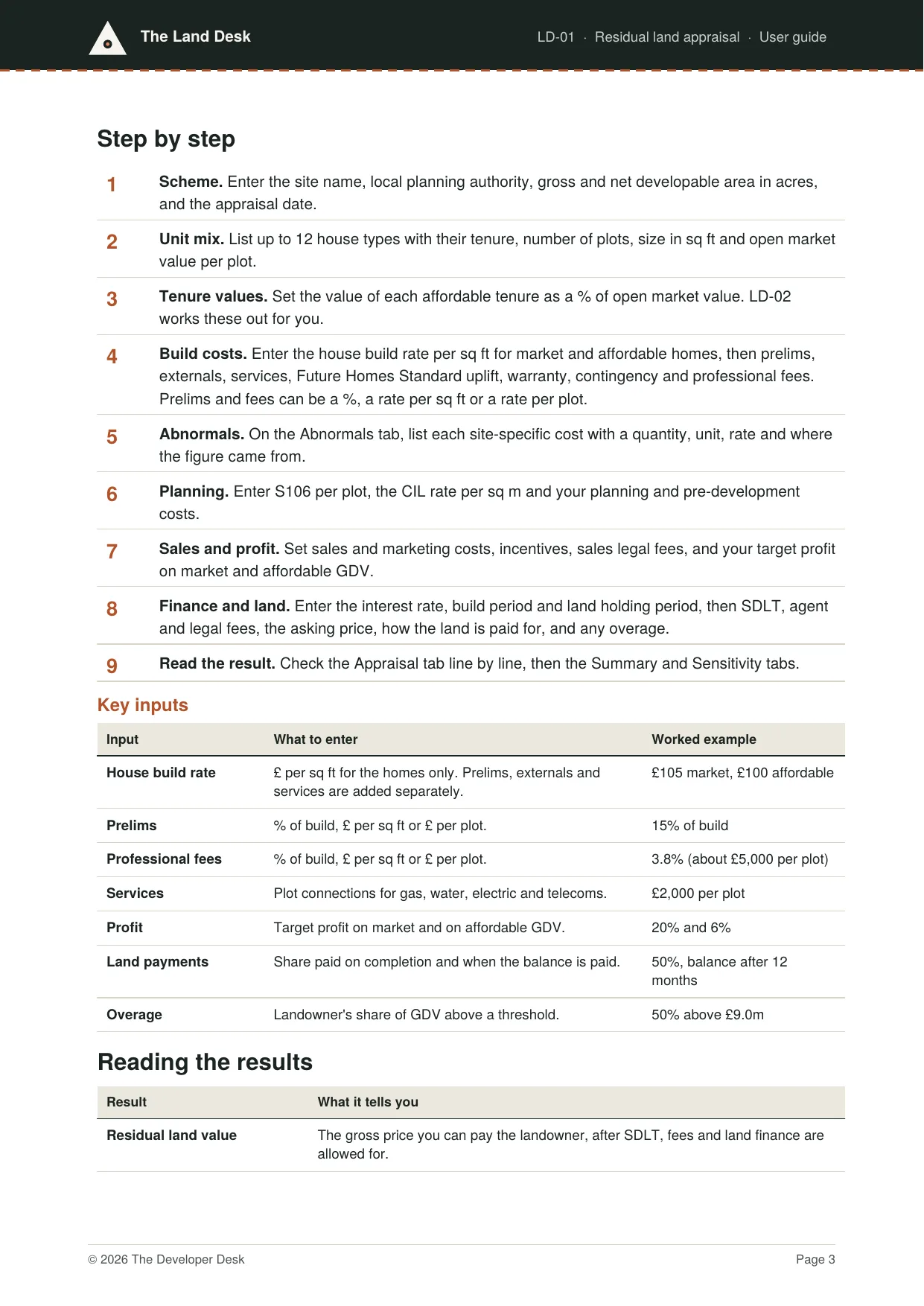
Every tool is a ready-to-use Excel workbook with a filled-in worked example and a PDF user guide. Buy one tool, a bundle of four or the full toolkit.
Appraisal bundle
Find the value in a site and back it up.Residual land appraisal
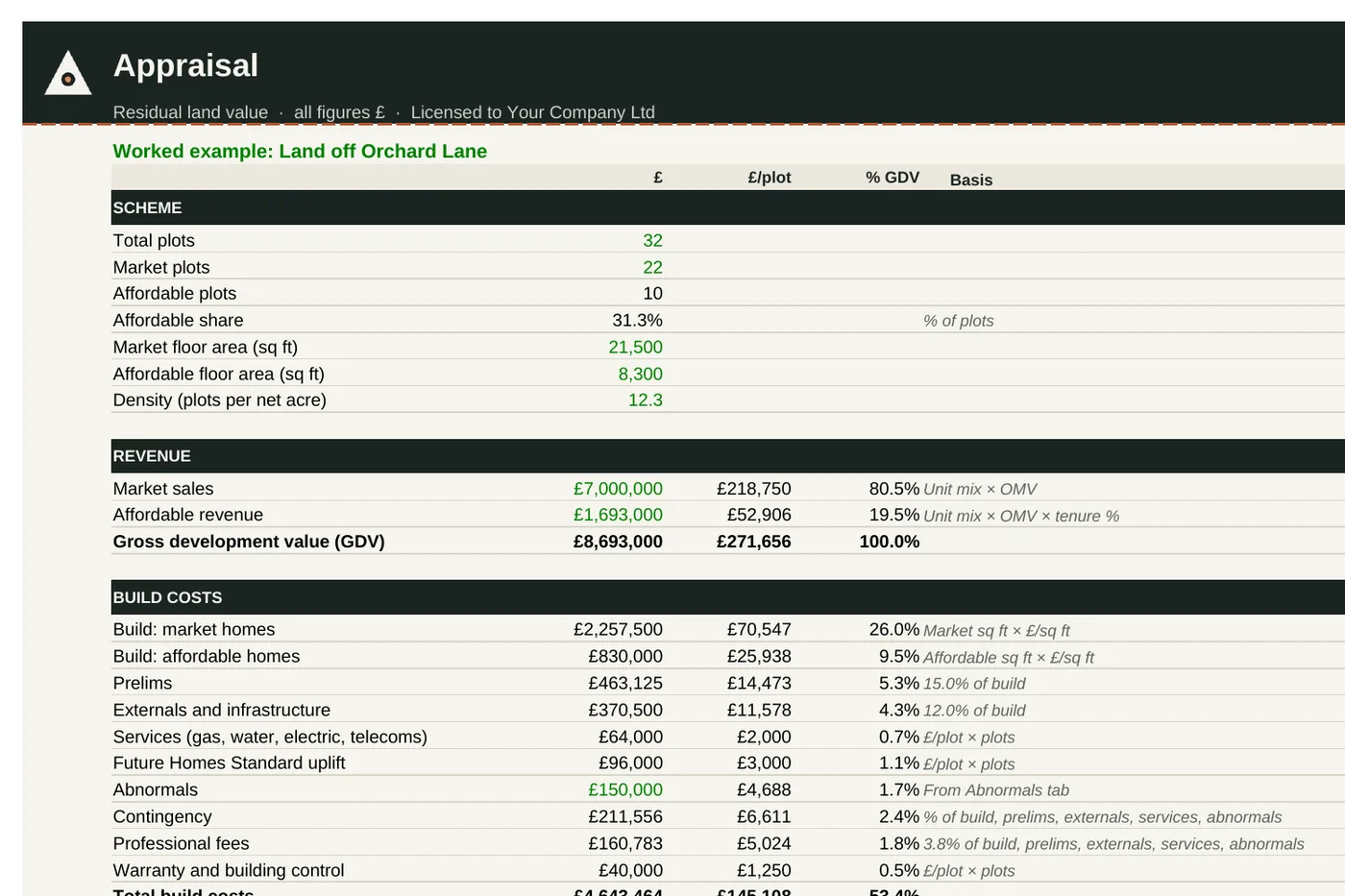
Unit mix, build costs, prelims, abnormals schedule, S106, CIL, fees, finance and profit to a land value, with land payment terms and overage.
- —Land value per acre and per plot
- —Headroom to asking price
- —5×5 sensitivity grid
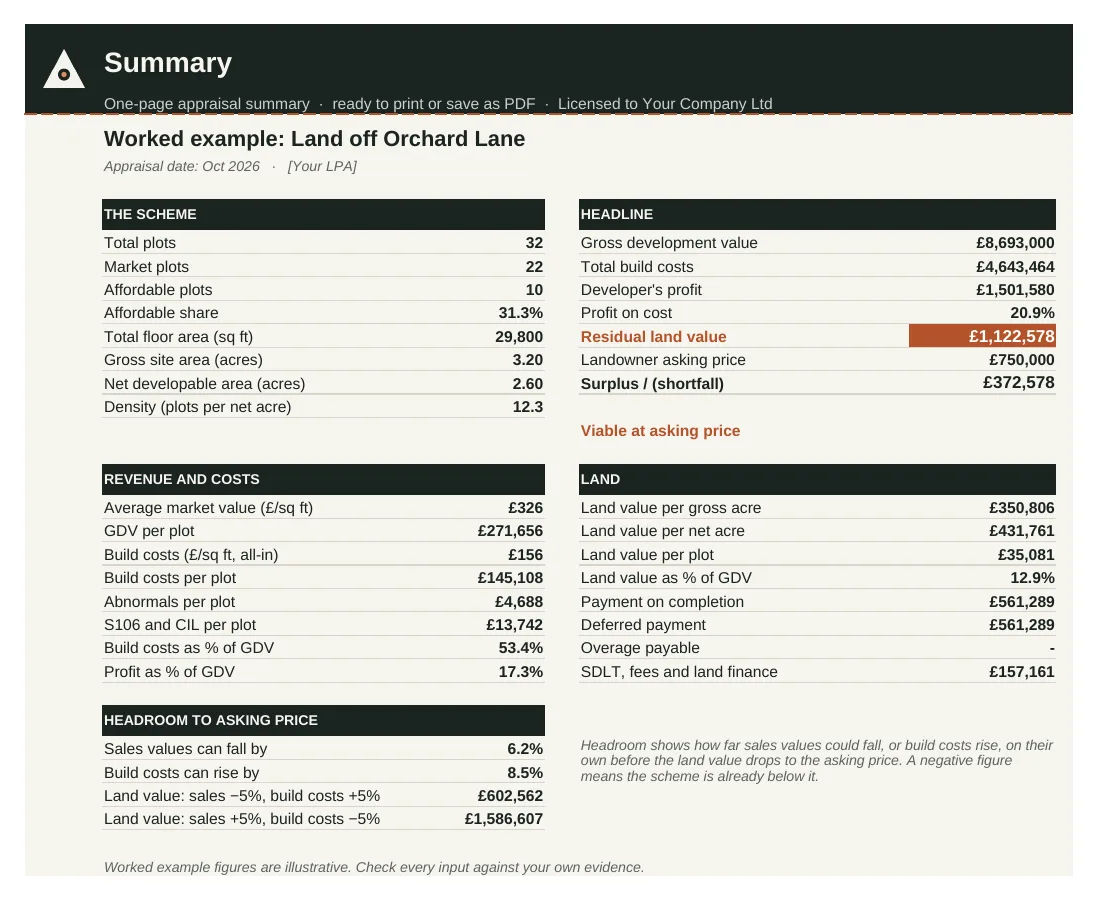
LD-01 takes your scheme's revenue, build costs, planning obligations, sales costs, finance and target profit, and works back to the price you can afford to pay the landowner: the residual land value. It then checks that price against the asking price and shows how far sales values or build costs could move before the deal stops working.
Who it's for: SME housebuilders appraising a site, RPs testing land-led schemes, and agents or consultants appraising for clients.
You enter: House build rate, Prelims, Professional fees, Services, Profit, Land payments, Overage.
You get: Residual land value, Land value per acre and per plot, Profit on cost, Surplus or shortfall, Headroom.
Tabs: Summary · Inputs · Abnormals · Appraisal · Sensitivity
Sales evidence and pricing
Adjusts comparables for time, asking discount, new-build premium and location, then prices each house type.
- —Weighted £ per sq ft by bedrooms
- —Evidence range for each type
- —Prices ready for LD-01
LD-09 takes recent sales and asking prices near your site and adjusts each one to today's money and to new-build. It then weights the evidence by how closely each comparable matches, gives you a £ per sq ft for each bedroom count, and prices your house types. The result goes straight into LD-01 as open market values.
Who it's for: SME housebuilders pricing a scheme, RPs checking shared ownership and market sale values, and anyone who needs to back up a GDV for a lender or board.
You enter: House price change, Asking price discount, New-build premium, Location adjustment, Weight.
You get: Adjusted £ per sq ft, Weighted £ per sq ft by bedrooms, House type prices, Market GDV.
Tabs: Summary · Inputs · Comparables
Build cost estimator
Prices each house type element by element at your chosen specification, plus site-wide works and on-costs.
- —Cost per plot and per sq ft
- —Where the money goes
- —Rates ready for LD-01
LD-16 prices each house type from substructure, superstructure, finishes, mechanical and electrical, kitchens and bathrooms, and garages, at a specification level you choose. It adds plot externals and services, site-wide works and abnormals, then prelims, contingency and fees. You get a cost per plot and per sq ft that carries straight into LD-01.
Who it's for: SME housebuilders and RPs appraising a site before a QS is appointed, and land teams sense-checking a contractor's price.
You enter: Substructure, Superstructure, Finishes and kitchens, Services, Prelims and contingency.
You get: House build £ per sq ft, Cost per plot, Total build cost, Where the money goes.
Tabs: Summary · Inputs · Estimate
Housing mix optimiser
Tests four housing mixes on the same site for land take, density and land value per acre.
- —Capacity and density checks
- —Mix rules built in
- —Best mix ranked
LD-15 compares up to four mixes of house types on the same site. For each it works out homes, floor area, density, how much of the site it needs, GDV, costs and a residual land value per acre. Mixes that need more land than you have, or break your mix rules, are flagged and left out of the ranking.
Who it's for: SME housebuilders and RPs at layout stage, and land teams deciding what to put on a site before instructing an architect.
You enter: Net developable area, Land take per home, Affordable housing and S106 impact, Minimum share of 1 and 2-bed homes.
You get: Share of net site used, Density, Residual land value, Rank.
Tabs: Summary · Inputs · Scenarios
Land deals bundle
Screen sites, structure the deal and fund it.Site screening scorecard
Scores up to 10 sites against 16 weighted criteria, with red flags that rule a site out.
- —Ranked shortlist
- —Pursue, review or decline
- —Weak spots by category
LD-11 scores up to 10 sites against 16 weighted criteria across planning, constraints, access, market, deliverability and commercial terms. It also checks five red flags that rule a site out whatever its score. You get a ranking, a recommendation for each site and the categories to look at first.
Who it's for: Land teams at SME housebuilders and RPs sifting new opportunities, and boards that want a consistent way to compare sites.
You enter: Weights, Scores, Red flags, Thresholds.
You get: Weighted score, Rank and recommendation, Score by category.
Tabs: Summary · Criteria · Scorecard
Option and promotion calculator
Compares an option, a promotion agreement and a conditional contract from both sides of the table.
- —Landowner and developer returns
- —Weighted for planning risk
- —Best deal for each party
LD-12 models the three common ways to secure land that doesn't yet have planning. For each it shows what the landowner receives and what the developer or promoter makes if planning is granted, then weights both by the chance of success and the time it takes. It tells you which deal suits each party, and how that changes if land values move.
Who it's for: Land teams negotiating strategic land deals, promoters, and RPs or landowners weighing up offers.
You enter: Land value with planning, Chance of planning, Time to planning, Option discount, Promotion fee.
You get: Landowner receives, Developer or promoter gain, Risk-weighted, today's money, Return on planning costs.
Tabs: Summary · Inputs · Comparison
Joint venture and profit share
Runs a land-for-equity JV through a waterfall: fee, capital back, preferred return, profit split.
- —Returns and multiples by partner
- —JV against an outright sale
- —Sensitivity to sales values
LD-13 models a joint venture where one partner puts in the land and the other puts in the cash. It runs the money through a waterfall: costs, a development management fee, each partner's capital back, a preferred return, then the profit split. It then compares each partner's result with a simple land sale.
Who it's for: SME housebuilders short of equity, landowners who want to share in the upside, and RPs exploring JV delivery.
You enter: Land put in by Partner A, Equity put in by Partner B, Development management fee, Preferred return, Profit split.
You get: Distributable cash, Waterfall, Returns, Against an outright sale.
Tabs: Summary · Inputs · Waterfall
Site cash flow
Five years by month: land, S-curve build spend, sales rate and RP tranches, funded by equity then debt.
- —Peak debt and interest
- —ROCE and IRRs
- —Year-by-year funder view
LD-04 turns your appraisal into a monthly cash flow over up to five years. It spends equity first and then debt, rolls up interest, repays debt from sales receipts and holds surplus cash for any late costs, giving you the numbers a funder or board will ask for.
Who it's for: SME housebuilders preparing funding applications and board papers, and RPs testing development cash flows.
You enter: Build profile, Sales rate, RP payments, Equity.
You get: Peak debt, Interest, ROCE, Project and equity IRR, Checks.
Tabs: Summary · Inputs · Cash flow
Affordable and partnerships bundle
Price affordable homes, test viability and bid for grant.Affordable and S106 pricing
Values social rent, affordable rent, shared ownership and First Homes the way an RP does, and compares up to four RP offers.
- —Package value by tenure
- —% of OMV for LD-01
- —Best offer against benchmark
LD-02 values each affordable home from first principles: capitalised net rent for social and affordable rent, first-tranche sale plus capitalised rent for shared ownership, and the discount for First Homes. It gives you a benchmark package value, compares up to four RP offers, and produces the % of open market value to use in LD-01.
Who it's for: Developers pricing S106 packages, small RPs checking their own offers, and consultants advising on affordable housing.
You enter: Affordable rent, Costs per plot per year, Capitalisation yield, Shared ownership, Grant.
You get: Package value by tenure, For LD-01, Offer comparison.
Tabs: Summary · Inputs · Valuation · RP offers
Partnership and package deal kit
Deal terms, a 32-clause heads of terms checklist with both sides' positions, a negotiation tracker and an offer letter that writes itself.
- —Payment timing in present value
- —Gap on open issues
- —One-page offer letter
LD-07 helps a developer and a registered provider agree a package of affordable homes: deal terms captured once, a heads of terms checklist with both sides' positions, a comparison of payment structures in present value, a negotiation tracker and an offer letter that writes itself.
Who it's for: Developers selling S106 and additional affordable homes, and small RPs making clear, consistent offers.
You enter: Package prices, Payment triggers, Cost of money, Clause status.
You get: Present value, Paid by start on site, Heads of terms agreed, Offer letter.
Tabs: Summary · Deal terms · Heads of terms · Payments · Negotiation · Offer letter
Planning viability assessment
Residual land value at policy against a benchmark of existing use value plus a premium.
- —Viable at policy, or not
- —Maximum viable affordable %
- —Cost of each 5% of affordable
LD-10 sets the residual land value at policy affordable housing against a benchmark land value made up of existing use value plus a premium for the landowner. If the scheme falls short, it works out the most affordable housing it can support. Use it to brief a viability consultant, or to see early whether a viability case is worth making.
Who it's for: SME housebuilders and promoters preparing for pre-application talks, and RPs testing a land-led scheme against policy.
You enter: Existing use value, Landowner premium, Policy affordable housing, Profit.
You get: Residual land value at policy, Surplus or deficit, Maximum viable affordable housing, Cost of each 5%.
Tabs: Summary · Inputs · Viability
Grant bid tool
Cost against value without grant for every home, so you ask for the grant you need, not more.
- —Grant by tenure and per home
- —Benchmark and S106 checks
- —Start-on-site window check
LD-14 compares the cost of delivering each affordable home with what it's worth without grant, and shows the grant actually needed. It checks your request against your own benchmarks per home, flags any line that asks for more than it needs or puts grant on S106 homes, and checks your start on site against the programme window.
Who it's for: RPs and SME housebuilders bidding for affordable housing grant, and land teams testing whether a grant-funded scheme stacks up.
You enter: Land cost per home, Build cost, On-costs, Value without grant, Benchmarks.
You get: Grant needed, Grant % of cost, Bid by tenure, Funder checks.
Tabs: Summary · Inputs · Bid
Land governance bundle
Control the bid, the approval and the run to start on site.Bid programme
Works back from the bid deadline in working days, with owners, dependencies and a weekly timeline. Slippage shows in red.
- —Latest start for every task
- —Needs-attention list
- —Next deadlines
LD-03 times every task in a land bid to finish just before the task it feeds into, working back from the bid deadline in working days. It then tracks progress, shows slippage in red, and lists what needs attention and what is due next.
Who it's for: Land teams at SME housebuilders and RPs bidding for sites, and consultants co-ordinating bid work.
You enter: Bid deadline, Contingency, Duration, Feeds into.
You get: Planned start and finish, Status, Slip, Timeline.
Tabs: Summary · Team and calendar · Programme
Land approval and gateway pack
Five gateways from opportunity to start on site, 48 checklist items, an approval matrix and an investment paper template.
- —Readiness by gateway
- —Who approves what
- —Board-ready paper
LD-05 sets out five gateways from opportunity to start on site, a checklist for each, an approval matrix showing who can sign off what, and an investment paper template for your board, so deals only move on when the work behind them is done.
Who it's for: SME housebuilder boards and land teams, small RPs setting up development governance, and funders wanting consistent papers.
You enter: Approval limits, Checklist status, Approvals sought.
You get: Readiness, Status, Approver.
Tabs: Summary · Approval matrix · Gateways · Checklists · Investment paper
Pre-development programme
Planning, S106, conditions, technical approvals and mobilisation, scheduled forward so any delay flows through to start on site.
- —Forecast vs target start
- —Automatic critical path
- —Key milestones
LD-06 schedules pre-application, planning, S106, the challenge period, conditions, technical approvals and mobilisation forwards from each task's predecessors. Any delay pushes everything after it, so you see at once whether start on site moves against your target. It works out the critical path for you.
Who it's for: SME housebuilders and RPs managing schemes through planning, and technical or development managers.
You enter: Duration, Predecessors, Lag, Forecast finish.
You get: Forecast start on site, Variance, Float, Status.
Tabs: Summary · Programme
Land pipeline tracker
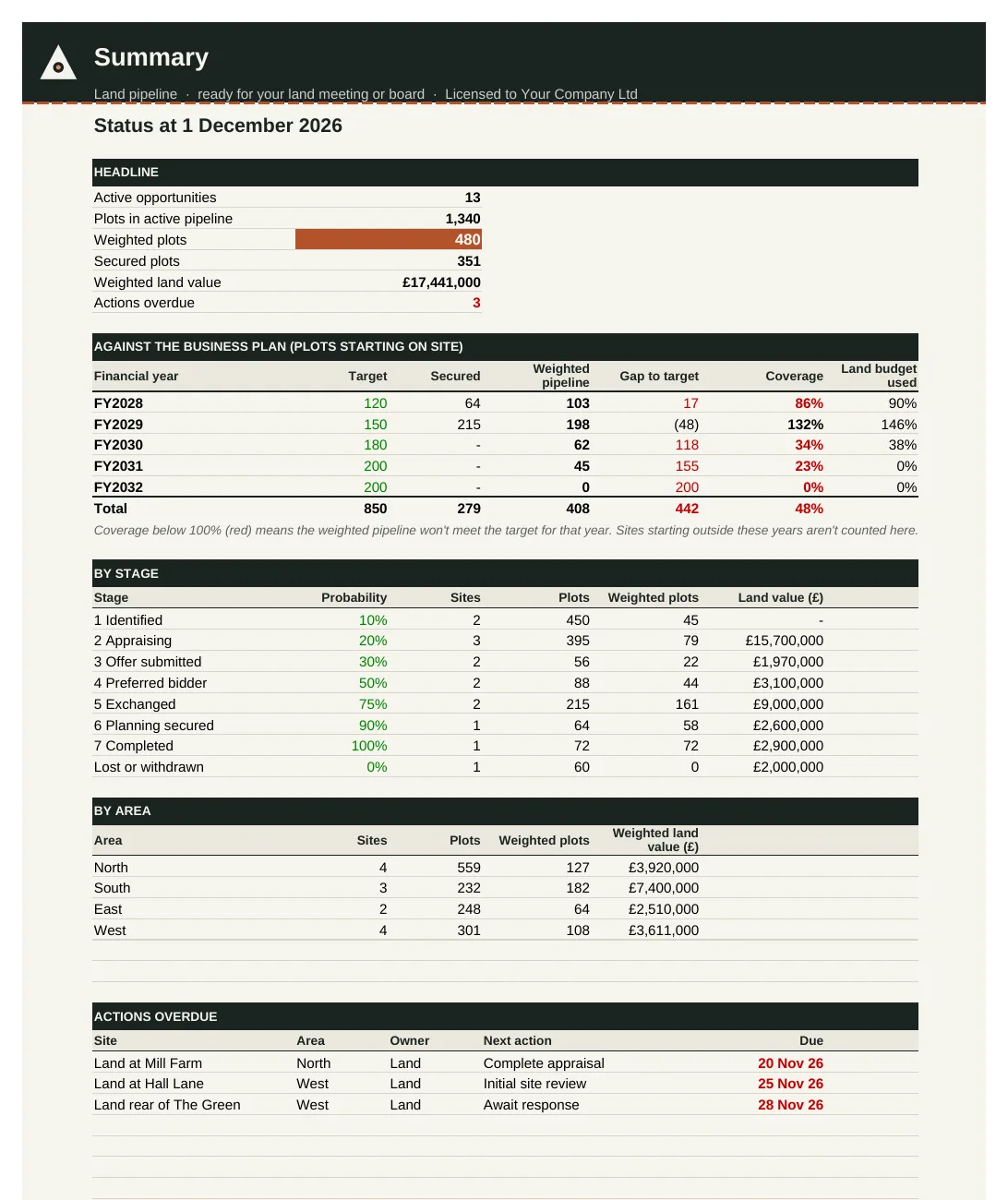
Every opportunity by stage, weighted by probability, and checked against your business plan year by year.
- —Coverage by financial year
- —Pipeline by stage and area
- —Overdue actions
LD-08 keeps every land opportunity in one place, from first identified to completed, and weights plots and land value by how likely each deal is to happen. It then checks the pipeline against your business plan year by year, so you can see shortfalls early.
Who it's for: Land directors and managers at SME housebuilders and RPs, and boards reviewing land supply.
You enter: Stage probabilities, Secured stages, Business plan, Expected start on site.
You get: Weighted plots, Coverage, By stage and area, Overdue actions.
Tabs: Summary · Settings · Pipeline
See inside
Real screens from the workbooks
Taken straight from the tools with the worked example filled in, so you can see exactly what you get before you buy.
In every tool
How it works
1 — Download
Buy a single tool, a bundle or the full toolkit. Each one is licensed to your company and sent by email.
2 — Set up once
Enter your build costs, sales values and target returns using the user guide.
3 — Appraise and bid
Run every new site through the same tools, and take a consistent paper to your board.
Pricing
Buy what you need, or get everything
Single tool
£95–£295
One workbook with its user guide and worked example.
Start here
Bundle of four
£295–£595
Four tools that work together. The appraisal bundle is the place to start.
Full toolkit
£1,495
All 16 tools and guides, yours to keep, with 12 months of updates and the monthly Q&A call. Then £395 a year to keep updating.
The Full Desk
£5,950
All six desks and all 96 tools, yours to keep, with 12 months of updates and the monthly Q&A call. Then £1,190 a year to keep updating.
Founding members: £4,450, with updates at £890 a year for life, for the first 50.
Set-up service
Your figures loaded for you · from £1,500
We load the tools with your own costs, rates, values, house types and approval rules, so they're ready to use from day one.
Prices exclude VAT. Single tools, bundles and desks are for one user and yours to keep. See pricing for every desk
Written by people who have done the job
The Land Desk is built by land and partnerships professionals who have appraised and bought sites, priced affordable packages with registered providers and taken deals through board approval at national and regional housebuilders.
Every tool is built from that experience: the checks, controls and numbers a well-run land business relies on, in a form you can pick up and use the same week.
Become a founding member
The first 50 founding members get The Full Desk, all six desks and 96 tools, for £4,450 instead of £5,950, with updates at £890 a year fixed for life. Join the list to claim a place and get a free sample appraisal.
The Land Desk is the first desk of The Developer Desk.
The Technical, Commercial, Build, Sales and Customer Desks are live now, all to the same standard and connected to your land appraisal. Add them one at a time, or get all six with The Full Desk.